


Common Terminology in Stone Cutting and the Stone Industry | From Block to Slab and Installation
Discover the most common terminology in stone cutting and the stone industry; from blocks, dimensions, and multi-wire machines to plaques, slabs, processing, sorting, bookmatching, and the essential terms of stone trading.
VisitCount 3
In the stone industry, each stage of the production process has its own language and terminology. “Block,” “dimension stone,” “tile,” “slab,” and “multi-wire” are just a few examples of the specialized terms used in the stone-cutting industry; terms that each describe a part of a specific process.
Before a stone becomes the façade of a building, the floor of a lobby, or the surface of a countertop, it goes through a long journey; from the extraction and preparation of raw stone to cutting, processing, finishing, and categorization. Throughout this journey, there are various terms whose proper understanding makes it easier to comprehend the production process and even to select the appropriate stone and equipment.
In the following, we will begin these terms with raw stone and step by step move on to cutting, stone-cutting products, processing and finishing, quality and categorization, arrangement and installation of stone, and finally the common terms used in buying and selling; so that by the end, we can have a clear picture of the specialized language of the stone industry and the process of transforming raw stone into the final product.
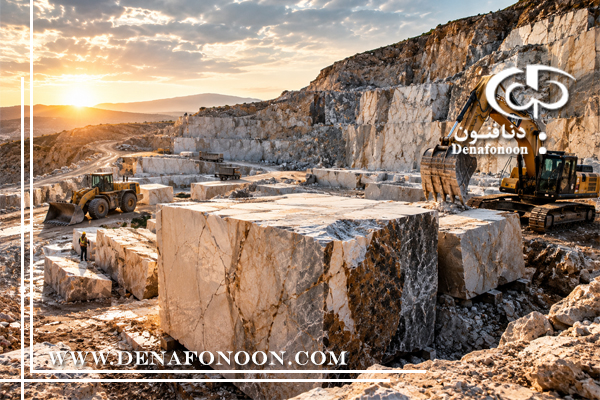
Table of Contents
3. Terms Related to Stone Cutting and Stone-Cutting Machines
4. Terms Related to Stone Products and Dimensions
5. Terms Related to Stone Processing and Finishing
6. Terms Related to Stone Quality, Appearance, and Categorization
7. Terms Related to Stone Arrangement and Installation
8. Common Terms Used in Buying and Selling Stone
9. Frequently Asked Questions About Stone Industry Terminology
10. Conclusion
1. Commonly Used Equipment and Tools in Stone Cutting
In a stone-cutting factory, various types of equipment and tools are used. From cutting and squaring blocks to processing, moving stone, and managing water and wastewater, each machine has a specific function. Below, we become familiar with the most important equipment and tools used in a stone-cutting environment.
Cutting and Stone-Squaring Equipment
Cutting is one of the main stages of stone processing, and various types of equipment are used to turn blocks into stone pieces and slabs. The most important ones include:
- Stone-cutting saw (block cutter)
- Multi-blade saws
- Multi-wire machine
- Diamond wire-saw machines
- Longitudinal and cross-cutting machine
- Slab-cutting machine
- Diamond cutting discs
- Diamond blades
- Diamond wire
Stone Processing, Grinding, and Finishing Equipment
After cutting, the stone goes through various processing stages to achieve the desired thickness, surface, and appearance. At this stage, grinding machines, polishing machines, and other surface-finishing equipment are used, including:
- Stone grinding machine
- Polishing machine
- Calibrating machine
- Resin-coating machine
- Epoxy machine
- Tumbling machine
- Brushing machine
- Flaming machine
- Shot-blasting machine
- Abrasive and polishing tools
- Industrial brushes
Block and Stone Handling Equipment
Due to the high weight of blocks and stone pieces, moving them around the factory requires suitable and safe equipment. Some of the common equipment used for transporting and handling stone includes:
- Overhead crane
- Gantry crane
- Forklift
- Workshop crane
- Hooks and chains
- Stone clamps and grips
- Vacuum lifter
- Pallets and slab-handling equipment
- Rollers and conveyor belts
Equipment Related to Stone-Cutting Wastewater
In the process of cutting and processing stone, water plays an important role. As a result of using water in the production line, wastewater containing mud and stone particles is also generated. For this reason, equipment related to the collection, transfer, separation, and dewatering of wastewater constitutes an important part of the equipment in a stone-cutting factory. The equipment used in this section includes:
- Wastewater collection basin
- Water and mud transfer pumps
- Sludge pump
- High-pressure gear pump
- Settling systems
- Clarifier
- Hydrocyclone
- Water storage tanks
- Water recycling system
- Filter press
- Filter press plates and cloths
- Mud-cake transfer and discharge equipment
This equipment plays an important role in wastewater management and returning water to the factory’s consumption cycle. Using a suitable system can help reduce fresh-water consumption and better manage the mud and sludge resulting from the production process.
Handheld and Workshop Tools
Alongside the main production-line equipment, handheld and workshop tools are also used for repairs, maintenance, adjustment, and technical activities in the factory. Some common tools include:
- Angle grinder and mini angle grinder
- Drill
- Welding machine
- Bench grinder
- Air compressor
- Jack and repair equipment
- Wrenches and mechanical tools
- Measuring equipment
- Caliper and measuring tape
- Manual cutting and grinding equipment
Consumable Materials and Items Used in Stone Cutting
In addition to the main machines and tools, various consumable materials and items are also used in the production process and maintenance of stone-cutting equipment. Some of these items include:
- Diamond blade
- Diamond wire
- Grinding tools
- Resin materials
- Epoxy
- Filler materials
- Stone adhesive
- Filter press cloth
- Filter press plates
- Industrial oil and grease
Understanding this equipment and consumable materials, in addition to providing better familiarity with the stone-cutting factory environment, also helps in understanding the technical terms and various processes of the stone industry,
2. Terms Related to Raw Stone and Extraction
Before stone is turned into tiles, slabs, or other products at the factory, it must first be extracted from the quarry and prepared for processing. At this stage, terms such as block, squared block, quarry stone, rubble, and waste are very common. Understanding these terms helps us better understand the difference between raw stone and processed stone.
What Is a Stone Block?
Block is one of the most commonly used terms in the stone industry and refers to a relatively large block of raw stone that has been extracted from the quarry and is ready to be transported to the factory and undergo subsequent processes.
The purpose of extracting building stone is to separate sound, intact blocks with suitable dimensions from the mass of stone as much as possible. The sounder the block is in terms of its internal structure and the more regular its shape, the greater the possibility of using it effectively in the subsequent stages.
However, the appearance of a block alone is not sufficient for evaluating it. Cracks, joints, fractures, veins, and changes in the stone’s texture can alter the amount of usable stone. For this reason, block quality is considered one of the important factors in valuing raw stone.
Simply put:
A block is the raw material that a stone-cutting factory processes to produce various stone products.
What Is a Squared Block?
A squared block is also one of the common terms used for pieces of raw stone with a relatively regular shape that can be used in the production process.
A squared block usually takes a shape that makes its cutting and processing easier after being separated from the main mass of stone and undergoing preparation operations. The dimensions, shape, and quality of a squared block may vary depending on the type of stone and the extraction method.
In the stone market, the semantic boundary between a block and a squared block is not always completely identical and fixed, and these two terms may be used differently in different regions or by different businesses. Therefore, when buying and selling raw stone, it is better to examine the actual dimensions, soundness, quality, and processing capability of the block in addition to the term being used.
Difference Between a Block and a Squared Block:
A block usually refers to a larger raw block that has been extracted directly from the quarry, while a squared block generally has a more regular shape and dimensions and is more prepared for cutting and processing. However, the use of these two terms may vary in different markets and regions.
What Is Quarry Stone?
Quarry stone is a term used in the stone industry to refer to raw stone extracted from a quarry, and in many cases it is used alongside the word “block.”
For this reason, you may encounter the phrase “block or quarry stone” in transactions or conversations related to quarries and factories.
The important point is that the common terms used in this field are not always applied with exactly the same definition in all regions and among all industry professionals. Therefore, understanding the practical use of the terms alongside their definitions is important.
What Is Stone Rubble?
Stone rubble refers to pieces of stone that usually do not have the regular shape and specific dimensions of a block or squared block.
Rubble can be generated during the extraction or cutting of stone. Unlike a block, whose main purpose of extraction is to produce a valuable and processable product, rubble is generally a more irregular piece and may have different applications depending on its size and quality.
For example, some types of rubble are used in wall construction, landscaping, paving, traditional construction, or the production of by-products.
Therefore, “rubble” does not necessarily mean worthless or unusable stone; rather, it mainly refers to the shape and condition of the stone piece.
What Is Stone Waste?
Waste refers to the portion of the materials resulting from extraction or processing that cannot be used to produce the main product or whose use is not economically justified.
Waste may include parts of stone that, due to fractures, poor quality, impurities, unsuitable dimensions, or other factors, cannot be turned into the main product.
However, waste does not always mean absolute discard. Depending on the type and size of the materials, part of it can be used in the production of by-products, construction materials, or other applications.
This issue is highly important in the stone industry, because reducing waste and reusing materials resulting from extraction and processing can help reduce costs and improve the management of resources and wastewater.
3. Terms Related to Stone Cutting and Stone-Cutting Machines
After the extraction of raw stone, one of the most important stages in the factory is cutting the stone block. The purpose of this stage is to turn the block or squared block into pieces and slabs that can be processed. The type of machine, cutting tool, desired thickness, and the characteristics
of the stone itself all affect the final result of this stage.
In the stone-cutting process, terms such as block cutter, saw, multi-wire, wire saw, diamond wire, and segment are used. Each of these terms refers to a specific machine, tool, or method in the cutting process.
What Is a Block Cutter?
A block cutter is one of the machines used to cut raw stone. In this machine, cutting is performed using a blade, and the stone is turned into pieces with the desired dimensions and thickness. The type of blade, its diameter, cutting speed, and the characteristics of the stone are among the factors that affect the machine’s performance and cutting quality.
One of the important points in selecting a cutting machine is that the type of machine must be compatible with the type of stone and the desired product.
A single cutting method cannot be considered the best option for all types of stone and all production lines.
What Is a Stone-Cutting Saw?
A stone-cutting saw, or sawing systems, is another main method for turning a stone block into stone slabs.
In stone-cutting saws, a set of blades can work on the block simultaneously and divide it into multiple slabs. In more traditional systems, this method is known as a gang saw.
In fact, a gang saw can be considered one of the important examples of sawing systems used for cutting stone blocks and producing slabs.
What Is a Multi-Wire?
A multi-wire is a stone-cutting technology in which several diamond cutting wires are used simultaneously to cut a block.
Unlike methods that use a single blade or a single wire, a multi-wire creates several cutting paths at the same time. This feature has made the technology attractive for high-capacity production lines and projects where cutting speed and efficiency are highly important.
The number of wires, the distance between them, and the machine settings can affect the number of slabs produced, cutting thickness, and line capacity.
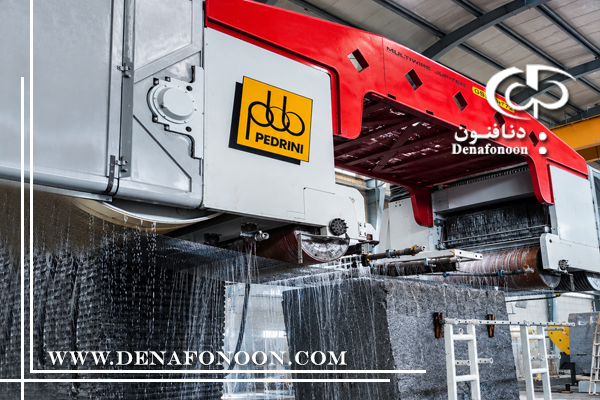
However, the performance of a multi-wire is not limited only to the number of wires. The quality of the diamond wire, the type of stone, cutting speed, the wire-tensioning system, and the machine settings also play a role in cutting quality and efficiency.
What Is a Gang Saw?
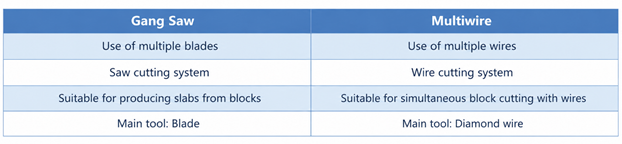
A gang saw refers to a sawing system in which a set of parallel blades cuts the stone block simultaneously.
The purpose of this system is to turn a single stone block into a large number of slabs with a specific thickness.
The main difference between a gang saw and a multi-wire lies in the cutting tool:
The choice of cutting method depends on the characteristics of the stone and production conditions, because each method performs differently in terms of speed, recovery rate, cost, and operation.
The choice of cutting method depends on the characteristics of the stone and production conditions, because each method performs differently in terms of speed, recovery rate, cost, and operation.
What Is a Wire Saw?
A wire saw refers to a cutting machine or system that uses a cutting wire to separate or cut stone.
The wire moves along a specific path and cuts the desired section of the stone. One of the important features of this method is the possibility of creating more specialized and flexible cuts compared with some blade-based methods.
From the quarry to the factory, wire saws are used to create various cuts in stone, and depending on the machine’s design, they can be used for different types of cutting.
What Is a Wire Saw?
A wire saw refers to a cutting machine or system that uses a cutting wire to separate or cut stone.
The wire moves along a specific path and cuts the desired section of the stone. One of the important features of this method is the possibility of creating more specialized and flexible cuts compared with some blade-based methods.
From the quarry to the factory, wire saws are used to create various cuts in stone, and depending on the machine’s design, they can be used for different types of cutting.
What Is Diamond Wire?
Diamond wire is one of the most important tools used in stone wire-cutting systems.
This wire consists of a wire core and a series of cutting elements containing diamonds. Due to its extremely high hardness, diamond makes it possible to cut hard materials such as stone.
The performance of diamond wire depends on various factors, such as the type of stone, diamond specifications, wire structure, movement speed, tension, and the machine’s working conditions.
For this reason, selecting the appropriate wire for each type of stone can have a significant effect on cutting speed, cut-surface quality, and tool life.
What Is a Segment?
A segment is a part of a cutting tool that usually contains diamonds and suitable matrix materials for holding and enabling the performance of the diamonds.
Segments play the main role in the cutting process of various stone-cutting tools, including diamond blades and diamond wires. In fact, when discussing the quality of a diamond tool, the specifications of the segment are one of the important factors that must be taken into consideration.
What Is Cutting Thickness or Product Thickness?
Another term used during stone cutting is cutting thickness or the thickness of the final product. The appropriate thickness depends on the type of product, its final application, project standards, and the production method.
The distance between cuts is not limited only to the final thickness of the stone, because part of this distance is related to the width of the cutting path and the space required for the cutting process.
For this reason, when calculating the production quantity of a block, it is not possible to consider only the volume of the stone; product thickness, cutting width, and the amount of waste are also important.
What Is Diamond Wire?
Diamond wire is one of the most important tools used in stone wire-cutting systems.
This wire consists of a wire core and a series of cutting elements containing diamonds. Due to its extremely high hardness, diamond makes it possible to cut hard materials such as stone.
The performance of diamond wire depends on various factors, such as the type of stone, diamond specifications, wire structure, movement speed, tension, and the machine’s working conditions.
For this reason, selecting the appropriate wire for each type of stone can have a significant effect on cutting speed, cut-surface quality, and tool life.
What Is a Segment?
A segment is a part of a cutting tool that usually contains diamonds and suitable matrix materials for holding and enabling the performance of the diamonds.
Segments play the main role in the cutting process of various stone-cutting tools, including diamond blades and diamond wires. In fact, when discussing the quality of a diamond tool, the specifications of the segment are one of the important factors that must be taken into consideration.
What Is Cutting Thickness or Product Thickness?
Another term used during stone cutting is cutting thickness or the thickness of the final product. The appropriate thickness depends on the type of product, its final application, project standards, and the production method.
The distance between cuts is not limited only to the final thickness of the stone, because part of this distance is related to the width of the cutting path and the space required for the cutting process.
For this reason, when calculating the production quantity of a block, it is not possible to consider only the volume of the stone; product thickness, cutting width, and the amount of waste are also
important.
4. Terms Related to Stone Products and Dimensions
After raw stone is cut, the product takes various forms depending on the type of cut, block dimensions, desired thickness, and final application. At this stage, terms such as tile, slab, stone tile, long stone, and cut-to-size stone enter the terminology of the stone industry.
Understanding these terms helps us know more precisely what type of product we are referring to when buying, selling, or processing stone.
What Is a Stone Tile?
Stone tile refers to stone slabs obtained by cutting blocks or pieces of raw stone, with specific thicknesses prepared for further processing or use in construction applications.
Tiles are usually produced in specific dimensions and thicknesses and are prepared according to the type of stone and its application, such as façades, floors, walls, stairs, and other parts of a building.
In the production process of stone tiles, factors such as block quality, cutting method, product thickness, and the amount of waste are highly important. For this reason, the final result is not limited only to the appearance of the stone surface; the way the raw stone is selected and cut also affects it.
What Is a Slab?
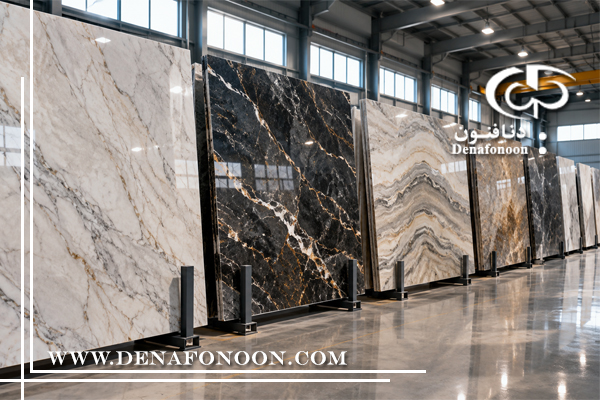
A slab refers to large stone slabs obtained by cutting raw stone blocks.
The most important feature of a slab is its large dimensions. These large dimensions allow the natural features of the stone, such as veins, waves, and color variations, to be seen across a wider surface.
For this reason, slabs are widely used in projects where the appearance of the stone is highly important, such as lobbies, feature walls, countertops, large floors, and luxurious interior spaces.
However, a slab is not merely a “large piece of stone.” Cutting quality, uniform thickness, surface soundness, processing, and the way slabs are selected and arranged all affect their value and application.
What Is the Difference Between a Stone Tile and a Slab?
These two terms are sometimes used interchangeably, but in the stone market, they usually do not refer to the same thing.
Simply put: a stone tile generally refers to stone slabs with more conventional dimensions that are suitable for common construction applications, while a slab refers to larger and more uniform stone slabs that are usually produced to better display the stone’s pattern and veins.The difference can be summarized as follows:
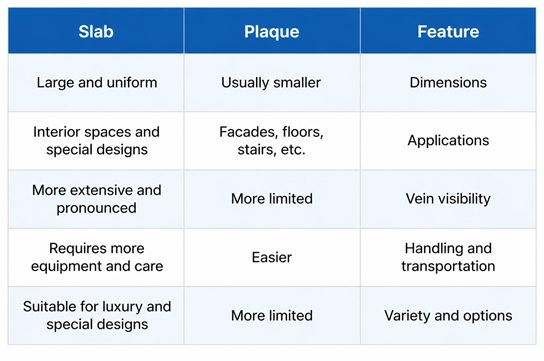
However, the exact dimensions and commercial definition of these terms may vary depending on the type of stone and common market practices.
What Is a Tile?
A tile refers to stone pieces with specific dimensions that are usually produced for installation on floors, walls, or other building surfaces.
Compared with slabs, tiles are smaller and more manageable pieces, which is why their transportation, cutting, and installation are usually easier.
One of the important differences between a tile and a slab is that, with tiles, the stone surface is divided into multiple pieces, while with slabs, efforts are made to keep the broad surface and natural pattern of the stone as intact as possible.
What Is Long Stone?
Long stone refers to stone pieces that are usually cut at a specific width and in lengths proportionate to the raw stone or the requirements of the project
This type of product is particularly used in applications such as building façades, stone frames, baseboards, and sections that require elongated pieces.
In the Iranian stone market, the term “long” mainly refers to the method of cutting and the dimensions of the piece and is not necessarily related to a specific type of stone.
What Is Cut-to-Size Stone?
Cut-to-size stone refers to pieces that have been cut to specific and predetermined dimensions. In fact, the term “cut-to-size” mainly indicates the specific and regular dimensions of the piece, not the type of stone. For example, when a piece of stone is produced for a specific application with precise dimensions, it can be classified as cut-to-size stone. This type of cutting becomes more important when the dimensions of the pieces must correspond to the plan, installation pattern, or dimensions of the intended space.
What Is a Stone Billet?
A stone billet refers to stone pieces with specific dimensions and shapes that can be used as raw material for producing other pieces or in certain specific applications. The exact application and definition of this term may vary depending on the type of stone and the product manufactured by the factory; therefore, in industrial transactions, it is better to examine the actual specifications, dimensions, and application of the product alongside the title “billet.”
What Is Paving Stone?
Paving stone refers to stone pieces that are produced and prepared for covering floors, outdoor areas, sidewalks, or similar spaces. Depending on the location of use, abrasion resistance, thickness, dimensions, type of surface finish, and water absorption are among the factors that become important when selecting paving stone.
Stone used in a high-traffic area naturally needs to differ in terms of technical characteristics from stone selected solely for a low-traffic space.
5. Terms Related to Stone Processing and Finishing
Cutting is not the end of the stone production process. Stone that comes out of the cutting machine has usually not yet achieved the desired final surface and appearance. During the processing and finishing stage, the surface of the stone is prepared using various methods so that characteristics such as smoothness, gloss, roughness, texture, and final appearance can be developed.
The choice of finish depends on the type of stone, its application, the place of use, and the desired appearance. This is why the same stone can have a completely different appearance and even feel when finished in different ways.

Stone Grinding
Grinding refers to a set of abrasive operations performed to smooth and even out the surface of the stone and prepare it for the subsequent stages of processing.
During the grinding process, the surface of the stone is gradually finished using various abrasive tools so that irregularities and marks remaining from the cutting stage are reduced.
In fact, grinding can be considered one of the basic stages of processing, and the quality of the subsequent stages depends largely on it.
Stone Polishing
Polishing is one of the best-known types of stone finishing, performed to create a smooth, glossy, and reflective surface. In this process, the stone surface reaches a level of smoothness through various abrasive stages and suitable materials that allows it to reflect more light. Polished stones are used in many interior and construction applications because of their glossy appearance and the enhanced display of their colors and veins.
Honed Finish
Honing is a type of finish that creates a smooth but matte or low-reflective surface.
The goal of this method is to achieve a uniform and soft surface without giving the stone the intense gloss of a polished surface. For this reason, honed stone is considered a suitable option for spaces where a more natural and matte appearance is desired.
Flamed Finish
Flaming is a type of surface finish that changes the texture of the stone surface through the use of controlled heat.
This process can create a more matte and rough surface, which is why it is used in some exterior applications and on surfaces where a more natural appearance and greater friction are required. The type of stone is highly important, and not all stones are suitable for this type of finish.
Leathered Finish
A leathered finish creates a surface with a soft texture and subtle elevations, producing an appearance different from that of a completely polished surface. In this type of finish, efforts are made to preserve some of the stone’s natural characteristics while giving the surface a tactile texture.
Leathered finishing has attracted attention for some natural stones, particularly in interior design and on surfaces such as countertops.
Bush-Hammered Finish
Bush hammering is a type of textured finish in which the stone surface is controlledly pounded or struck using a specialized tool.
The result is a surface with a regular, grainy texture that takes the stone’s appearance away from a smooth and polished state.
This type of finish is mainly considered when creating texture and a more natural appearance on the stone is important.
Sandblasting
Sandblasting is a method of changing the texture of a stone surface using a stream of abrasive materials.
In this method, abrasive materials move across the stone surface under pressure and can create a more matte and textured surface.
The intensity of the operation, the type of abrasive material, and the process conditions affect the final result.
Brushing
Brushing is a type of surface finish that creates a distinctive texture on the stone surface using brush-like and abrasive tools. This method is usually used to create a more natural and slightly textured appearance and can make the elevations and natural characteristics of the stone more visible.
Stone Resin Treatment
Resin treatment is one of the common processes used in preparing some natural stones. In this process, resin materials are used to fill or cover certain pores, cracks, and surface discontinuities.
The purpose of resin treatment may be to improve the appearance of the surface, fill cavities, and increase the stone’s visual uniformity. After resin treatment, further stages such as grinding and polishing are usually performed so that the surface reaches the desired final quality.
Does the Type of Finish Affect the Appearance of Stone?
Absolutely. One of the most attractive features of stone processing is that a single stone can have a completely different appearance when its finish is changed. A polished surface can make the stone’s colors and veins appear more vivid and glossy, while a honed finish creates a calmer and more matte appearance. Textured finishes such as flaming, bush hammering, or brushing can also give the surface a more natural and distinctive appearance.
Therefore, when selecting stone, you should not ask only:
“What type of stone is it?”
There is another important question:
“What finish has it been processed with?”
Because sometimes the main difference is not something that exists within the stone itself, but rather something that has happened on the surface of the stone.
6. Terms Related to Stone Quality, Appearance, and Categorization
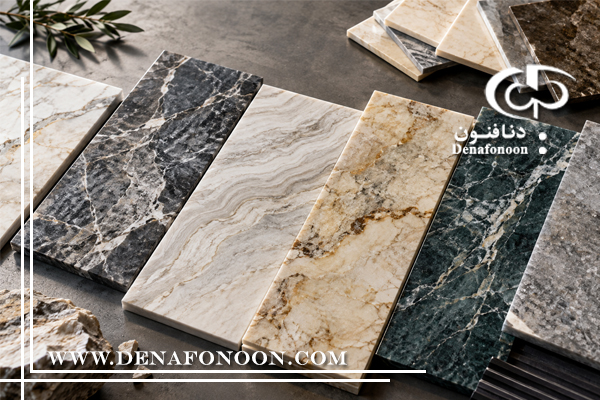
The appearance of a stone is not limited only to its color. When a block enters the factory, various characteristics such as color, pattern, veining, degree of uniformity, porosity, strength, and surface quality are examined to determine which applications the stone is suitable for.
To describe the visual and technical characteristics of stone, terms such as sorting, veining, waves, porosity, and abrasion resistance are used.
Stone Sorting
Sorting is one of the most commonly used terms in the stone market and refers to the process of categorizing stones based on their visual and quality characteristics.
After cutting and processing, not all pieces of a stone necessarily have the same appearance. Some pieces may have more uniform color, fewer veins, or higher visual quality, while others may have differences in appearance.
In the sorting process, stones are categorized based on factors such as:
Degree of color uniformity
Intensity and type of veining
Presence of spots or impurities
Surface quality
Degree of coordination between the pieces
For this reason, when terms such as premium sort, first sort, or lower sorts are used in the market, they usually refer to the level of quality and visual coordination of the stone.
Stone Veining
Veining refers to the natural lines, bands, or patterns present in the structure of the stone.
These veins result from geological processes during the formation of the stone and are considered one of the most important visual characteristics in many building stones.
In some stones, veining is considered a strength because it creates distinctive and unique patterns, especially in slabs intended for use in prominent spaces.
Stone Waves
Stone waves refer to the linear or curved patterns visible on the surface of some stones.
These waves may result from the natural structure of the stone, its layers of formation, or the direction of cutting.
In some stones, waves increase visual value and are highly sought after for designs such as feature walls or decorative slabs.
In contrast, for some applications, stones with a calmer and more uniform appearance may be selected.
Stone Porosity
Porosity refers to the presence of empty spaces or pores within the internal structure of the stone.
The degree of porosity can affect characteristics such as:
-Water absorption
-Resistance to environmental conditions
-Stone durability
-The way the stone is used in different spaces
Stones selected for humid environments or special conditions should be evaluated in terms of porosity and water absorption.
Stone Water Absorption
Water absorption indicates how much water a stone can take into its structure.
This characteristic is one of the important technical specifications of stone, because the amount of water absorption can affect the selection of stone for different applications.
For example, stone used on the exterior of a building must be better able to withstand environmental conditions such as rainfall and temperature changes.
Stone Abrasion Resistance
Abrasion resistance indicates the stone’s ability to withstand wear caused by contact and foot traffic.
This characteristic is more important for stones used on the floors of high-traffic spaces. For example, the flooring stone of a busy public space must have more suitable abrasion-resistance characteristics than a decorative stone used in a low-traffic area.
Stone Flexural Strength
Flexural strength indicates the ability of stone to withstand bending forces before failure. This characteristic is important in areas where the stone is subjected to pressure or special installation conditions. When selecting stone, visual beauty alone is not sufficient, and its technical specifications must also correspond to the place of use.
How Is Stone Quality Graded?
Stone grading is usually the result of examining a set of factors, not merely one specific characteristic.
Factors such as:
-Stone soundness
-Color uniformity
-Type of veining
-Processing quality
-Dimensions and thickness
-Technical characteristics
can all affect the final value and application of the stone. For this reason, a stone with a very attractive appearance but unsuitable technical characteristics is not always the best choice for a particular project.
7. Terms Related to Stone Arrangement and Installation
After extraction, cutting, and processing, the stone reaches the installation stage; the stage in which the result of all the previous stages becomes visible. At this stage, in addition to the quality of the stone itself, the way the pieces are selected, placed next to one another, and installed is also highly important. Particularly in stones with natural veins and patterns, proper arrangement can completely change the final appearance of the project.
In the construction and stone industries, terms such as bookmatch, four-match, vein match, anchoring, dry installation, and stone joint are used to describe methods of arranging and installing stone.
Bookmatch
Bookmatch is one of the commonly used terms in the installation of slab stones.
In this method, two stone slabs cut from consecutive sections of the stone are placed next to each other in such a way that their natural patterns and veins create a symmetrical appearance, like the opened pages of a book. For this reason, the name of this method is derived from the English term “Book Match.” Bookmatching is mainly used in spaces where the appearance of the stone plays the central role in the design, such as:
-Feature walls
-Lobbies
-Behind television units
-Luxury interior spaces
-Countertops
In this method, the correct selection of slabs is highly important, because the coordination of the veins and the natural pattern of the stone must be examined before installation. The way the slabs are positioned next to each other can also have a significant effect on the final result, particularly in spaces where the pattern and veins of the stone are an important part of the design.

Four-Match
Four-match is a stone arrangement in which four stone pieces are placed next to one another in a way that creates a continuous and symmetrical pattern. In fact, four-match can be considered a more developed form of bookmatch, because instead of coordinating two pieces, four pieces create a larger composition together. This method is usually used for large spaces and projects where creating a unified image of the stone pattern is important.
Vein Match
Vein match, or arrangement based on veining, refers to a method in which the direction and continuation of the stone’s natural veins are coordinated during installation. In stones with distinct veins, the way the slabs are positioned can cause the veins to create a natural and visually appealing path.
The main difference between vein match and bookmatch is that vein match primarily focuses on the direction in which the veins move, rather than necessarily creating complete symmetry.
Stone Anchoring
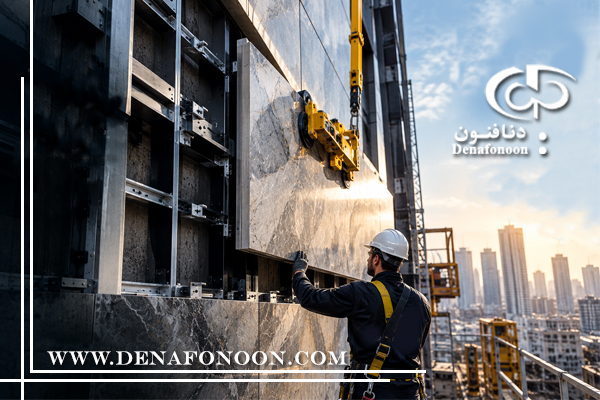
Stone anchoring is one of the methods used to increase safety during stone installation, particularly on building façades. In this method, the back of the stone is connected to the structure using tools or fastening components to reduce the possibility of the stone becoming detached.
Anchoring becomes more important when the stone is installed at height and the weight of the stone pieces requires secure restraint. However, the installation method, materials used, and project conditions must be evaluated by specialists.
Dry Stone Installation
Dry installation is a method of installing stone in which the stone is installed without using traditional mortar, with the help of mechanical systems, profiles, or special connections. This method has attracted attention in many modern projects due to advantages such as:
-Higher installation speed
-Better control over alignment and spacing
-Reduced dependence on mortar
-Easier repair or replacement
However, the choice of installation method depends on the type of stone, place of use, building design, and installation conditions.
Stone Jointing
Stone jointing refers to the distance or space created between stone pieces during the installation process. The quantity and the manner in which these joints are executed can have a significant impact on the final appearance of the surface.
In some designs, efforts are made to minimize the visibility of the joints to ensure the stone surface appears more seamless and integrated. Conversely, in certain applications, distinct spacing between the slabs is considered an intentional part of the overall design.
Stone Fixtures and Fasteners
In some modern execution methods, specialized connecting components and systems are utilized to hold and stabilize the stone; these are referred to as fasteners or fixtures.
These tools gain particular importance in dry-fix installations and high-end projects that require a high degree of precision and structural stability.
8. Common Terms in Stone Trading
A significant portion of the terminology used in the stone industry is not limited to quarries or factories. During the stages of trading, expert evaluation, pricing, and selection for a specific project, there are various terms that, when understood, can prevent many common misunderstandings.
In the stone market, the price and value of a product are not solely dependent on the name of the stone. Factors such as color, pattern, consistency, integrity, dimensions, thickness, the type of processing, and even the method of presentation and categorization can influence the final value. For this reason, some common trading terms serve more as indicators of the product's market status rather than as fixed technical definitions.
What is First-Grade Stone?
First-grade (Grade A) usually refers to stones that rank higher in terms of visual and technical characteristics compared to the standard samples of the same stone type. However, grading is not a universally standardized term across the entire stone market, and the criteria may vary from one stone type to another or from one supplier to another. For instance, in one type of stone, color consistency may be the primary criterion, while in another, the beauty and continuity of the veins may be the main factor.
What Does "Export-Grade Stone" Mean?
The term "Export-Grade" is typically used in the market for products that meet the requirements of international markets in terms of quality, processing, packaging, or visual characteristics.
However, being "export-grade" does not necessarily mean that all such stones share identical specifications. The destination country, the required standards, the type of product, and its intended application can all create different criteria.
Therefore, when purchasing export-grade stone, it is advisable to examine the actual specifications—such as dimensions, thickness, processing type, surface quality, and consistency—rather than relying solely on the product's title.
What Does "Consistency" in Stone Mean?
When a stone is described as "consistent" (uniform), it usually refers to a higher level of harmony among the pieces regarding color, background, and visual characteristics.
However, consistency is not always an indicator of superior quality. Some stones derive high visual value from their natural veins and variations, and these differences are precisely what make them beautiful. Consequently, consistency should be evaluated based on the type of stone and the specific requirements of the project.
What Do "Premium," "Super," and "Standard" Sorts Mean?
In market transactions, terms such as "Super Sort," "Premium," or "First-Grade" are used to refer to the visual and qualitative ranking of products. Nevertheless, these terms lack a uniform technical standard across the market and may vary between different stone types or suppliers. For this reason, when comparing two products, one should not rely exclusively on labels like "Premium" or "Super," but should instead analyze the actual specifications of the stone, including: color, the amount and type of veining, surface integrity, thickness, dimensions, and the quality of processing.
What is "Linear Stone" (Stone by Length) in the Market?
Linear stone refers to pieces that are typically supplied with a fixed width but varying lengths.
This type of stone is commonly used for facades, framing, skirting, curbs, and other architectural details. The advantage is that the pieces are pre-prepared with a specific width for linear and elongated applications. In contrast, "Fixed-Dimension Stone" (Hokmi) is cut based on predefined and specific measurements. Therefore, the difference between these two terms relates more to how the product's dimensions are defined rather than the type of stone itself.
Veined vs. Non-Veined Stone
Veining is a natural characteristic of many stones and can play a significant role in their selection and pricing. Veined stones may be more attractive for projects where the natural pattern of the stone is intended to be a focal point. Conversely, for certain spaces, a stone with a more uniform background may be preferred.
It is important to note that the presence of veins is not inherently a sign of weakness or low quality. The type of vein, its placement, continuity, the structural characteristics of the stone, and the final application must all be carefully considered.
Face vs. Back of the Stone
In certain transactions and processing stages, distinguishing between the face and the back of the stone is crucial.
The "face" is the surface that, after processing and finishing, is exposed to view. The "back" is typically the surface that remains hidden or faces the substrate during installation. In processed stones, surface quality, thickness uniformity, and the method of cutting are essential factors in the correct identification and utilization of the pieces.
9. Frequently Asked Questions Regarding Stone Industry Terminology
1. What is meant by the "integrity of the block," and what factors should be examined when purchasing a block?
The integrity of a block is not limited to the visual soundness of its surface. A block may appear monolithic from the outside but contain internal cracks, fractures, or discontinuities. These internal defects can lead to a reduction in the yield of usable stone or compromise the quality of the final product during the cutting process. Consequently, when evaluating a block, one must consider not only the surface appearance, dimensions, and shape but also the status of fractures, internal structure, vein direction, and processability. Ultimately, the most valuable block is one that allows for the production of high-quality finished products.
2. Why is the cutting direction critical for veined stones?
The natural veins of a stone are intrinsic to its structure and appearance; therefore, the orientation of the cut relative to the block's axis can completely alter the final pattern.If a block is cut in a different direction, the veins may appear as long linear streaks, wavy patterns, or entirely different motifs on the slab surface. Thus, the cutting direction is not merely a technical production decision but a factor that directly influences the visual appeal and value of the final product. For this reason, before cutting veined stones, it must be clearly determined which specific natural pattern is intended to be showcased on the surface.
3. Why can a single block produce slabs with different appearances?
A block is a mass of natural stone with a complex internal structure; color, veining, and texture are not necessarily uniform throughout. In addition to these natural internal variations, the cutting direction, the position of each slice within the block, and the alignment of layers and veins can all create differences between slabs.
Consequently, even slabs derived from the same block may not be identical. In natural stone, this is an inherent characteristic of the product. In projects requiring the coordination of multiple slabs, this variability must be carefully managed starting from the selection and cutting stages.
4. What is "cutting waste" in the stone industry, and what factors increase it?
Cutting waste refers to the portion of the stone that is not converted into a usable final product during the cutting or preparation process.
The amount of waste depends on factors such as the dimensions and shape of the block, existing cracks and fractures, the thickness and width of the cutting path (kerf), the cutting method, and the production planning. Therefore, reducing waste is not solely a matter of equipment selection; the quality of the raw stone and the execution of the cutting process also significantly impact the overall yield.
5. Why might two slabs from the same block be unsuitable for bookmatching?
Bookmatching occurs only when two slabs can create a harmonious composition through their natural patterns, veins, and directional alignment. The mere fact that two slabs originate from the same block does not guarantee they are suitable for bookmatching. The sequence of the slabs, the cutting direction, their relative position within the block, and the continuity of the veins are all critical factors.
For this reason, to achieve a successful bookmatch, slabs must be evaluated and selected as a coordinated set, rather than simply pairing two pieces based on the fact that they are the same stone type.
10. Conclusion
Understanding the terminology of the stone industry is not merely about memorizing a few technical terms; these terms constitute a common language that connects the various segments of the stone supply chain. When we comprehend the meaning of each term and its role in the process of production, processing, procurement, or installation, our decision-making regarding product selection, equipment, and the appropriate execution method becomes far more precise. The stone industry is a synergy between the natural characteristics of the raw material and the precision of human processes.
Therefore, the deeper our understanding of this professional language, the better we can perceive the true value of the stone and the intricate journey it undertakes from the quarry to the final product.